
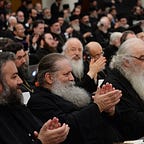

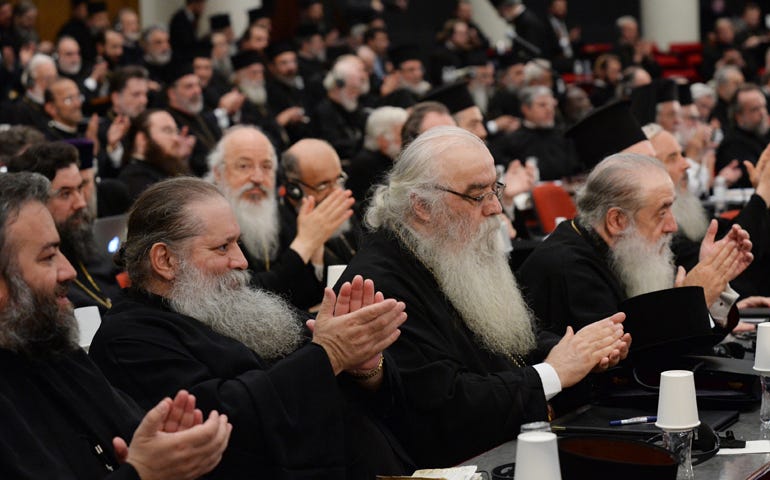
It has been a decade since the 2016 Pan-Orthodox Council took place in Crete. Some may consider it a flop; others may hail some of its decisions as important in world Orthodoxy (albeit, these hails seem to be quite faint). The Russian Church, the largest by numbers and accounting for approximately half of all Orthodox Christians in the world, did not participate in the Council, and neither did the Churches of Antioch, Georgia, and Bulgaria. The Orthodox Church in America (OCA) was not invited. Should the Good Lord tarry, there will be another council eventually, and the organizers may do a better job next time.
The idea of convening a pan-Orthodox council may date as far back as 1902. In 1930, one of the earliest meetings of an inter-Orthodox preparatory committee was held on Mount Athos. Two World Wars later, in 1961, the preparations began in earnest with a meeting of a pan-Orthodox conference in Rhodes. In 1968, the preparatory committee met in Geneva and prepared drafts of some of the documents. One of those documents is of particular interest to our project; it is titled The harmonization of ecclesiastical rules on fasting with the requirements of modern life.1
Unfortunately, what was adopted in 2016 is nowhere near as useful as what was proposed in 1968. The 2016 document titled The importance of fasting and its observance today consists of nine paragraphs, eight of which are little more than pious platitudes of no practical importance. Paragraph nine is the only one worth re-visiting here:
Fasting for three or more days prior to Holy Communion is left to the discretion of the piety of the faithful, according to the words of Saint Nicodemus the Hagiorite: “… fasting before partaking of Communion is not decreed by the divine Canons. Nevertheless, those who are able to fast even a whole week before it, are doing the right thing” (Commentary of the 13th canon of Sixth Ecumenical Council, Pedalion – English translation 307). However, the totality of the Church’s faithful must observe the holy fasts and the abstinence from food from midnight for frequent participation in Holy Communion, which is the most profound expression of the essence of the Church. The faithful should become accustomed to fasting as an expression of repentance, as the fulfillment of a spiritual pledge, to achieve a particular spiritual end in times of temptation, in conjunction with supplications to God, for adults approaching the sacrament of baptism, prior to ordination, in cases where penance is imposed, as well as during pilgrimages and other similar instances.
Abstain from food from midnight and become accustomed to fasting to achieve a particular spiritual end. (It is rather unfortunate that the latter clause is not elaborated.) While it is not necessarily completely useless to re-state the obvious from time to time, it is nonetheless disappointing that it took over a century of preparation and an elevated council convened at a great expense to remind the faithful that they should fast before Communion.
The 1968 document was far more interesting and useful. It was prepared by the Church of Serbia and included an overview of the fasting discipline beginning with pre-Christian times as well as a number of recommendations for the faithful of our time. We may return to the aforementioned overview in another post, for it is interesting in its own right, but for now, let us take a closer look at the practical recommendations:
All currently valid orders regarding fasting are to be strictly observed by monks and those who wish to do so from the sacred clergy and pious people.
Note: This point creates a two-tier system - one for monastics and those who wish to imitate them (at least in the fasting discipline) and a different one for everyone else. This seems sensible, considering that the current fasting practice was developed by monks for monks and was not necessarily meant for lay people carrying their cross in the world. (It seems unclear what is meant by “all currently valid orders,” but since this is directed primarily at monks, we shall not dwell on this here.)
All other Christians who have difficulties in following the existing orders about fasting due to conditions of life, climate, the availability of fasting food, and also with the aim of preserving in God’s people the mindfulness of the sacred institution of fasting and temperance, to allow the consumption of certain, non-fasting, in modern understanding, foodstuffs, which must be understood as a softening of the fast.
Note: Once again, there is that word - “orders”; and once again, it is unclear what the Serbs mean by that. Are there actual orders or even decrees issued by Serbian hierarchs concerning fasting? It may be interesting to peruse some of these orders. As for the larger point, and as we have discussed repeatedly elsewhere, the fasting rules as we have them were developed in the Mediterranean world, and it seems unreasonable to rely on shrimp while living in the Mid-West or to look for olive oil in Upstate New York. To be sure, these foods may be available through global transportation networks and refrigeration, but it is hardly sustainable to observe a fast while relying on products from another part of the globe or ones that cost several times the price of local food. Such practices destroy the essence of the Christian fast and turn it into a rabbinical practice of kashrut - a very, very different discipline.
Observe the fast on Wednesdays and Fridays all year but with the allowance of plant oil and fish, except the times when these days coincide with the feasts of the Elevation of the Cross, Beheading of John the Forerunner, Eve of Theophany, and also Wednesdays and Fridays of Great Lent.
Leave in place the orders of the Typikon concerning Wednesdays and Fridays of fast-free weeks. Besides this, allow the consumption of non-fasting foods on all Wednesdays and Fridays in the period from Thomas Sunday until Ascension.
Note: That is to say, this point makes the entire 40 days from Pascha to Ascension fast-free. Some traditions already do this - contrary to the Typikon - but not the Russian tradition, and, apparently, not the Serbian one either.
Keep the length of Great Lent in its present form, according to the instructions of the Typikon and its orders concerning the quality and kind of food in the First and Passion Weeks. On all other days of Lent - from the second week until Palm Sunday - allow the consumption of fish and plant oil, except on Wednesdays and Fridays (see par. 3).
Note: What is obviously missing from this recommendation is any mention of actual fasting during Lent - that is to say, abstaining from food until evening, for example, as we have discussed numerous times elsewhere. Perhaps, the Commission is leaving this question to the discretion of each individual Christian (which, perhaps, would be quite sensible, if it were so).
Concerning the Nativity Fast, the Commission offers two options:
a) to shorten it to 20 days, beginning the fast on the day following the memory of Great Martyr Barbara (see instruction in the Typikon), and during the entirety of the fast, allow the consumption of fish and plant oil, except for the last five days, or
b) to keep the fast at 40 days and allow fish and oil on all days, except the first three and the last three, in which to keep a strict fast.
Limit Peter’s Fast to eight days before the Feast of the Apostles Peter and Paul, when the period between the Sunday of All Saints and the Feast is more than eight days. During the entirety of the Fast, allow fish and plant oil.
Keep the Dormition Fast in its present form in length, but allow the consumption of fish and plant oil on all days, except Wednesdays and Fridays.
Allow the consumption of non-fasting food on the Feasts of Peter and Paul and Dormition, if they happen to fall on Wednesday or Friday
It seems clear that what the Commission proposed was the return to earlier fasting practices - perhaps, more than a thousand years earlier in some cases - before the monastic rules and “orders” as we know them were fully developed, and before they gradually gained influence in the lives of the laity. This is certainly not an unreasonable direction to take: make lengthy fasts less lengthy or less strict in order to allow for stricter and more meaningful observances of shorter fasts and special days immediately before major feasts. If these recommendations were ever adopted by the Church, they would eliminate the unnecessary and unproductive feelings of guilt by those who cannot keep monastic “orders,” while allowing those so inclined to keep as strict a fast as they wish (which, to be fair, has always been an option). Another important point is brought up in recommendation number two which mentions both climate and the availability of certain products. While this recommendation does not elaborate, it nonetheless has the potential of beginning a much -needed conversation about reasonable adaptations of Mediterranean dietary expectations to climates and circumstances very different from what is experienced in Greece or Italy.
This is what could have been at the Pan-Orthodox Council. Perhaps, with God’s help, the various primates and hierarchs of the Local Churches may one day overcome their differences and gather in a true pan-Orthodox manner; and maybe then more meaningful documents will be adopted. But considering that it took over a century just to have the Council of 2016, we may not witness the next one in our lifetime.
“Even so, come Lord Jesus.” (Rev 22:20)
As always, if you liked this post, please share it with your friends and relations; and if you are saving money by fasting without lobster and sea scallops, consider gifting someone a subscription to Phroneo. Phroneo is not produced in China - it is completely local - so it is one of the few gifts you can give without paying a tariff.
Журнал Московской Патриархии, 1972, № 4, стр. 49-54.


