

The Dormition Fast is a sad example of the division caused among Orthodox Churches by the use of two different calendars. Those on the old calendar fast from August 14 to 27 and celebrate the Feast of Dormition on August 28. Those on the new calendar begin their fast on August 1 and celebrate Dormition on August 15. Thus, the two groups of “calendarists” fast together for only one day, August 14, and do not celebrate together at all. Of course, this is not a problem in isolated communities but presents an obstacle to fellowship for Christians from two communities following different calendars. It can only be hoped that the merciful Lord, who prayed that all of His disciples be united, will grant wisdom to church leaders to heal this unfortunate division.
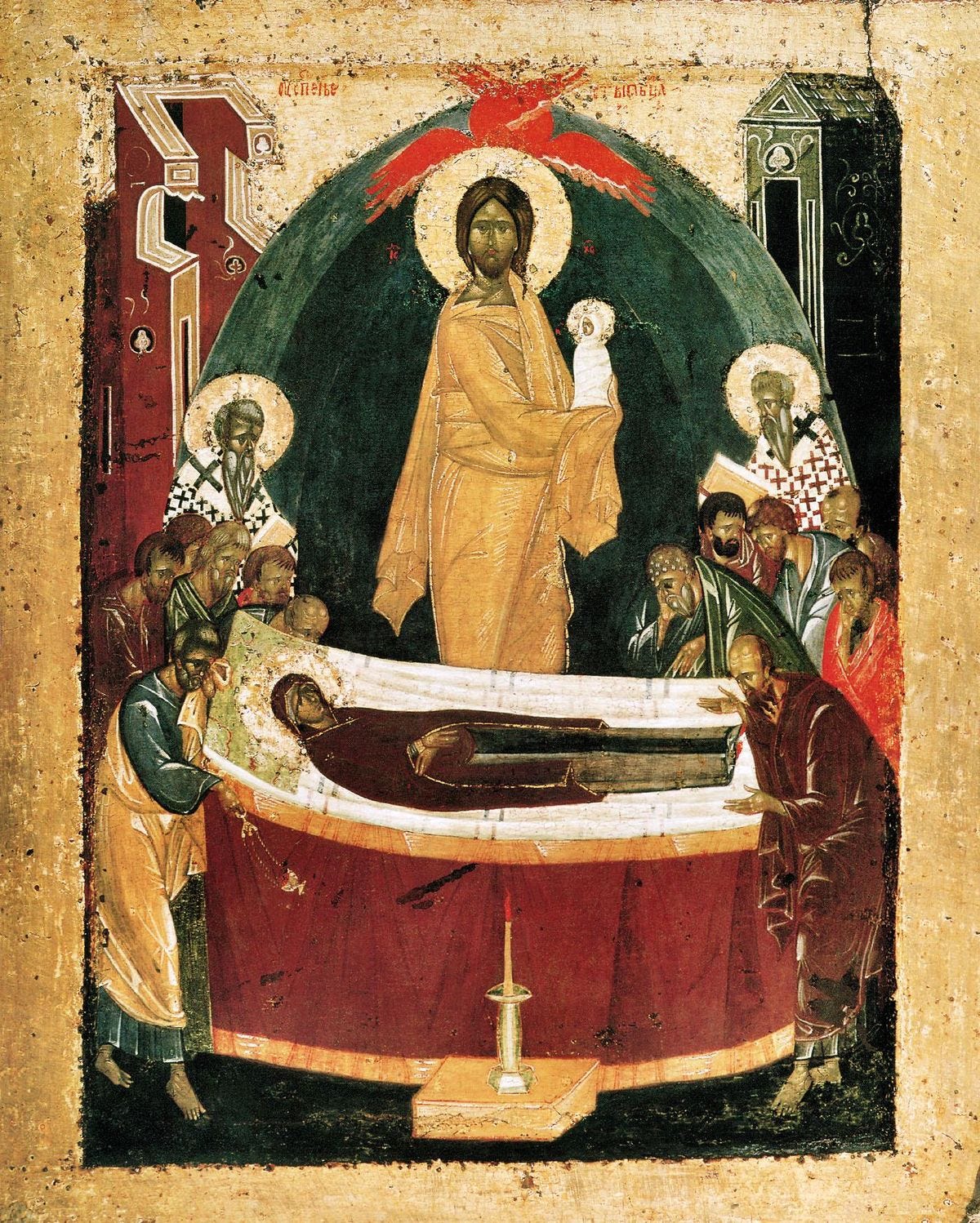
Fresco by Theophan the Greek, 1392
Dormition Fast was likely observed in some form, perhaps as short as one day, for as long as Dormition was celebrated - likely, from the fifth century - but no definite mention of this fast appears until the ninth century - not even in the Typikons of monasteries. However, an epistle by Saint Theodore the Studite (759-826) titled Διδασκαλία χρονική τῆς Μονής τοῦ Στουδίου1 does mention the fast before Dormition, further showing that this tradition existed in Constantinople at that time. In this epistle, Saint Theodore writes that the Dormition Fast is to be kept in the same manner as the Nativity Fast and the Fast of the Holy Apostles: “on Monday, Wednesday, and Friday.”2 That is to say, on Monday, Wednesday, and Friday a fast is observed all day until it is broken in the evening with a meal consisting of xerophagy. It appears from the wording that Tuesdays and Thursdays were different - perhaps, in that two meals were offered, with the first of the two being earlier in the day.3 The present-day Typikon prescribes fasting until the 9th hour on all five of the week-days, the difference being only in the meal that is used for the breaking of the fast in the evening.
In 920, a local Council in Constantinople mentioned the Dormition Fast but only indirectly. In 1085, monks on Mount Athos seem to have found this mention and were confused about the existence of this fast of which they had not known. And it was not until the 1166 Council that Dormition Fast was finally and officially regularized. The confusion about the exact dates of this fast may be found in one of the Typikons4 of that time period, which states that the fast begins on August 1, but because this is the feast of the Maccabees, actual fasting does not begin until August 2. Theodore Balsamon, the Patriarch of Antioch5 from 1193 to 1199, is known to have written numerous letters and encyclicals urging his flock to keep the Dormition Fast, which fact may indicate that it was not widely observed in Antioch prior to the end of the 12th century.
Be that as it may, the present-day fasting rules found in the Sabaite Typikon, chapter 33 are as follows:
It is necessary to know about the Fast of the Most Holy Theotokos:
In the fast of the Dormition of our Holy Lady Theotokos, 15 days6 except Christ’s Transfiguration, we fast until the 9th hour (3 p.m.) on Monday, Wednesday, and Friday, and eat xerophagy7… On Tuesday and Thursday - cooked food without oil. On Saturday and Sunday - cooked food with oil, and we drink wine; fish, however, we do not eat until the Dormition of the Theotokos; only on Christ’s Transfiguration do we eat fish twice in that day.
It is important to remember that this is a monastic rule, and lay people are certainly under no obligation to observe monastic rules. However, because Dormition Fast is relatively short - only two weeks, it seems to be the perfect opportunity to practice stricter fasting without experiencing a burn-out, and there are many options for experimentation. One may, for example, observe a stricter fast on Wednesday and Friday or also on Monday. The same may try fasting until noon or 3 p.m. or 6 p.m.; or try each option to determine which may suit him best. To be sure, fasting is not only about abstaining from food or is not primarily about abstaining from food. In much the same way, education is not about primary school, and yet attempting to send a seven-year-old directly to graduate school may not be a good strategy. It is the same with fasting: fasting may be the first and the easiest step of Christian asceticism, but this is precisely why it makes a strong and necessary foundation for loftier aspirations and should not be disregarded. No one who intends to build a temple begins with the dome but rather establishes a proper foundation first. It is the same with the temple of our soul: one who aspires to such heights as noetic arts, would do well to begin with a proper foundation in the practice of fasting among other disciplines and not build his house on the sand of mere dreams, thoughts, and wishes about things divine (cf. Matt 7:26, 27).
***
As always, if you enjoyed this post, may I ask you to share it with your friends? And if you are saving money by experimenting with fasting, perhaps you will consider giving Phroneo as a gift to someone you think might enjoy it as much as you do. Thank you.
Διδασκαλία χρονική τῆς Μονής τοῦ Στουδίου, PG. T 99. Col. 1693
ibid., Col. 1701, par. 11
Compare this with fasting instructions for Great Lent, in which the fast is broken by one evening meal on all week-days.
Namely, a Calabrian version of the Studite Typikon of Patriarch Alexis.
While Balsamon was nominally the Patriarch of Antioch, he actually lived in Constantinople.
This is likely simply a reference to the fast lasting from the 1st day of the month to the 15th, not to the exact number of fasting days, of which there are 14, if one were to count all days, including Saturdays, Sundays, and the Feast of Transfiguration.
Saint Savva of Serbia, in his Rule for the Hilandar monastery on Mount Athos, described xerophagy thusly: “grains soaked in water and some raw greens and fruit” (ch. 10).


